Sugar is sometimes discussed as a simple concrete retarder. In practice, however, its effect is not simply “add sugar and get more time.” A recent mortar and cement-paste trial shows a more useful lesson: sugar can significantly delay setting, but the result depends on cement, water-binder ratio, supplementary cementitious materials, temperature, and the way it is combined with other retarders such as sodium gluconate.
Thank you for reading this post, don't forget to subscribe!For concrete producers and admixture formulators, the key takeaway is clear: retarding performance is valuable only when it is predictable.
What the Trial Looked At
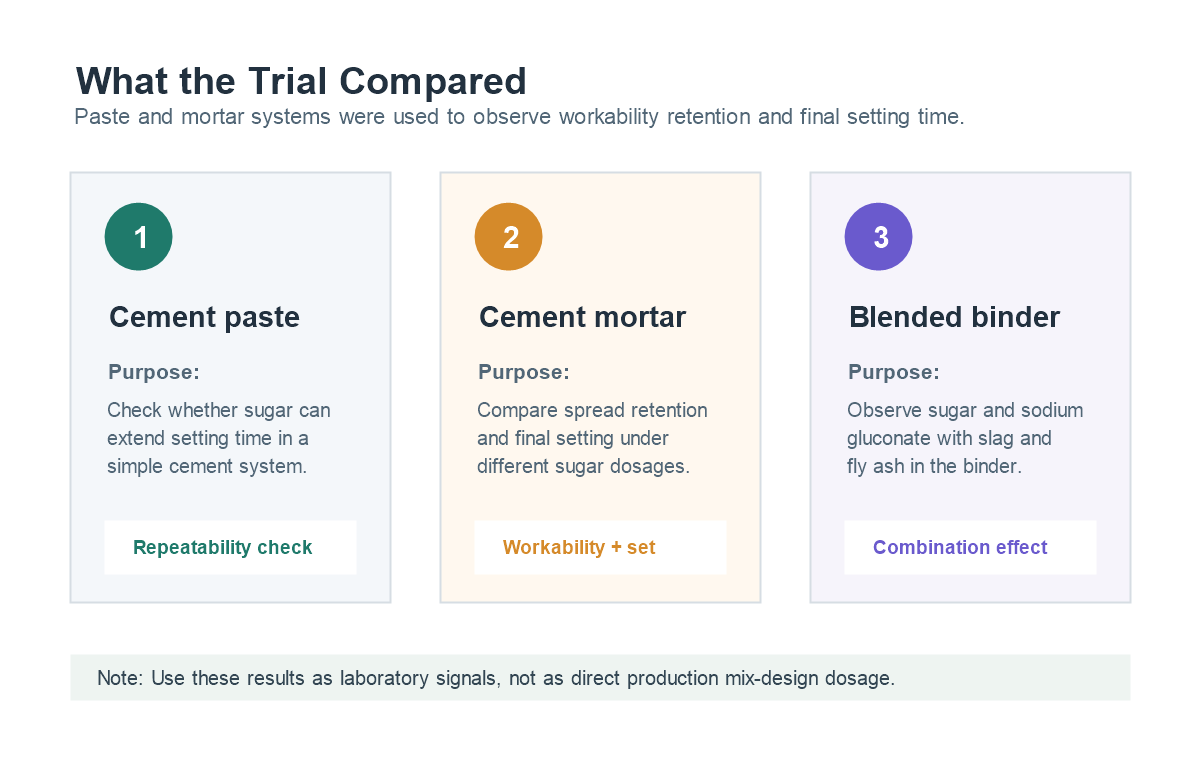
The source experiment compared sugar in three related systems: cement paste, pure cement mortar, and mortar with slag and fly ash replacing part of the cement. This setup matters because cement paste does not always predict real mortar or concrete behavior. A material may show a clear effect in paste but behave differently once sand, higher water-binder ratio, mineral admixtures, and field workability requirements are introduced.
Main Observation: Sugar Strongly Delayed Setting
In the cement-paste check, adding sugar extended the setting time. The purpose was not to prove a new mechanism, but to confirm that the delaying effect could be repeated with another cement source.
In the pure cement mortar system, sugar clearly improved workability retention. However, the one-hour loss did not follow a perfectly linear trend as the sugar dosage increased. One trial group showed an unusually large spread value, which the original experiment treated as possible test error.
The setting-time change was more obvious. The blank pure mortar group reached final set at about 6 hours. The high-sugar trial extended final setting to about 12 hours. Intermediate values were estimated in the source record because some timing notes were missed, so they should be treated as directional rather than exact design data.
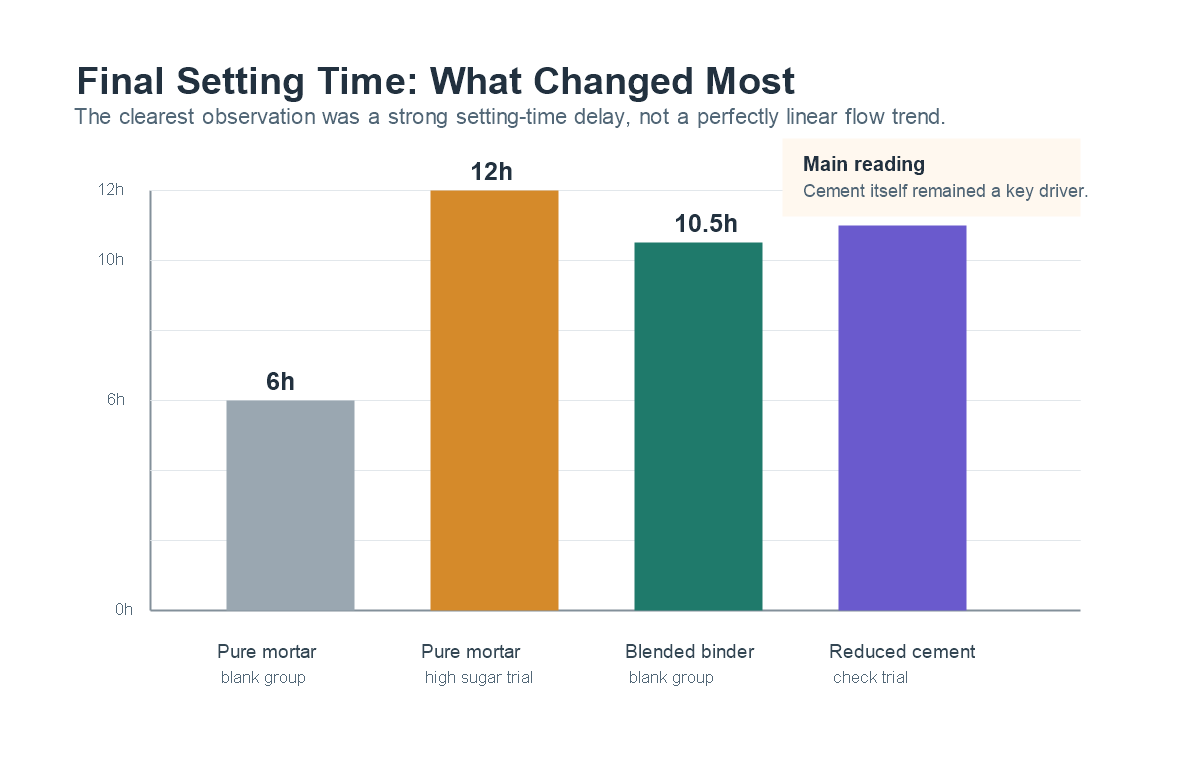
The blended binder system added another useful point. When slag and fly ash replaced part of the cement, the blank group’s final setting time increased from about 6 hours to about 10.5 hours. A follow-up check using a reduced cement quantity showed a similar final setting time of around 11 hours. This suggests that cement quantity and cement characteristics were dominant drivers in this trial, while slag and fly ash were not the first variables to blame for the longer setting time.
Sugar vs. Sodium Gluconate
The experiment also compared sugar with sodium gluconate, a widely used retarder and workability-retention aid in concrete admixtures.
Two practical differences stood out: sugar had a stronger influence on final setting time than sodium gluconate in the tested system, while sodium gluconate produced a more stable improvement in spread across cement paste, mortar, and concrete-related observations.
The source notes also recorded field-style behavior: sodium gluconate used alone can increase surface bleeding, while sugar used alone can make the mix feel sticky. A combined approach can reduce the weakness of each single component and may improve two-hour spread retention, especially in warmer conditions.
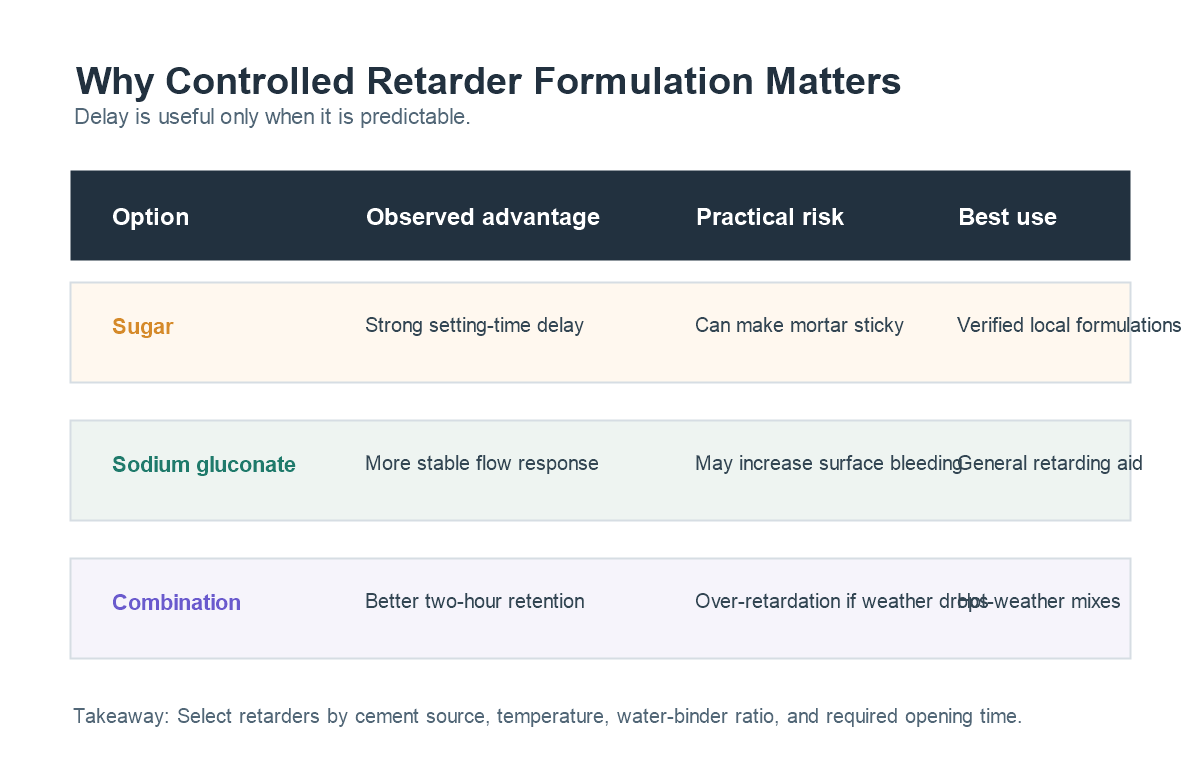
This does not mean sugar should be copied directly into a production concrete mix. Instead, it shows why retarder packages are usually optimized as systems. A workable formulation may combine sodium gluconate with a carbohydrate-based retarder, but the right balance depends on local cement, admixture solids, sand grading, temperature, transport time, and required opening time.
Temperature and Cement Source Matter
The source trial was carried out at roughly 25 C. That detail matters. At higher temperatures, concrete may lose workability faster and need stronger retention support. At lower temperatures, the same retarder dosage may push final setting too far beyond the construction schedule.
Cement source is equally important. Some modern cements already have longer setting behavior while still meeting broad specification limits. For projects that need fast finishing or quick turnover, a cement with long inherent setting time can create problems even before any retarder is added.
This is why a retarder dosage that works in one plant may fail in another. The chemistry is not isolated from the jobsite.
Practical Lessons for Concrete Admixture Formulation
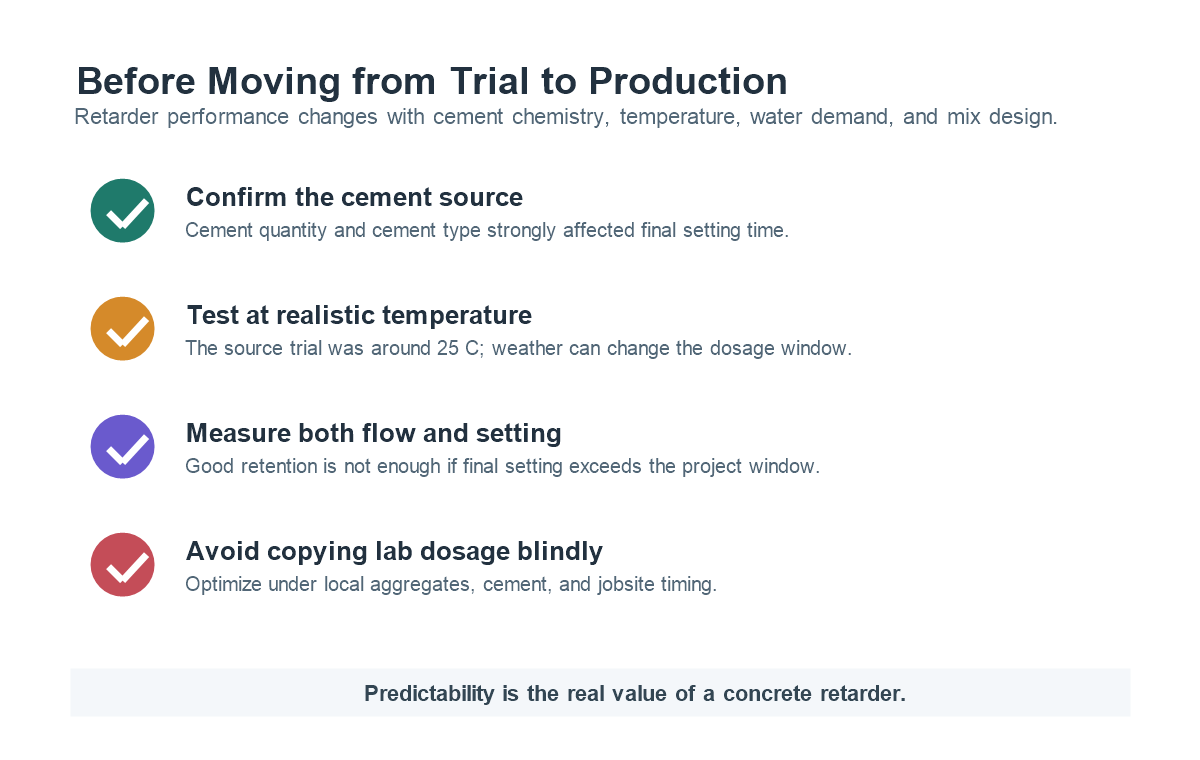
For ready-mix concrete, dry-mix mortar, and wet-mix mortar producers, the trial points to four practical lessons.
- Do not evaluate retarder performance only through cement paste. Paste tests are useful for screening, but they can overstate or misrepresent how the system behaves in mortar or concrete.
- Measure both spread retention and final setting time. A mix that stays fluid for two hours is not automatically suitable if the final set moves beyond the project’s working window.
- Check the cement before changing the retarder package. In this trial, cement quantity and cement characteristics had a large effect on final setting time.
- Validate dosage under realistic temperature. Sugar and sodium gluconate combinations may be useful in hot-weather formulations, but the same package can over-retard concrete when weather changes.
Conclusion
Sugar can act as a strong concrete retarder, and the trial confirms that it can significantly extend final setting time. But its behavior is not a simple linear dosage story. It can improve retention, create stickiness, interact with cement source, and shift setting time more strongly than expected.
For industrial concrete admixture design, the better conclusion is not “use sugar.” The better conclusion is: use controlled retarder chemistry, verify it in the real binder system, and design around the actual construction window.
That is where sodium gluconate and carbohydrate-based retarder combinations become useful. They give formulators a practical way to balance workability retention, setting-time control, bleeding risk, and field stability.